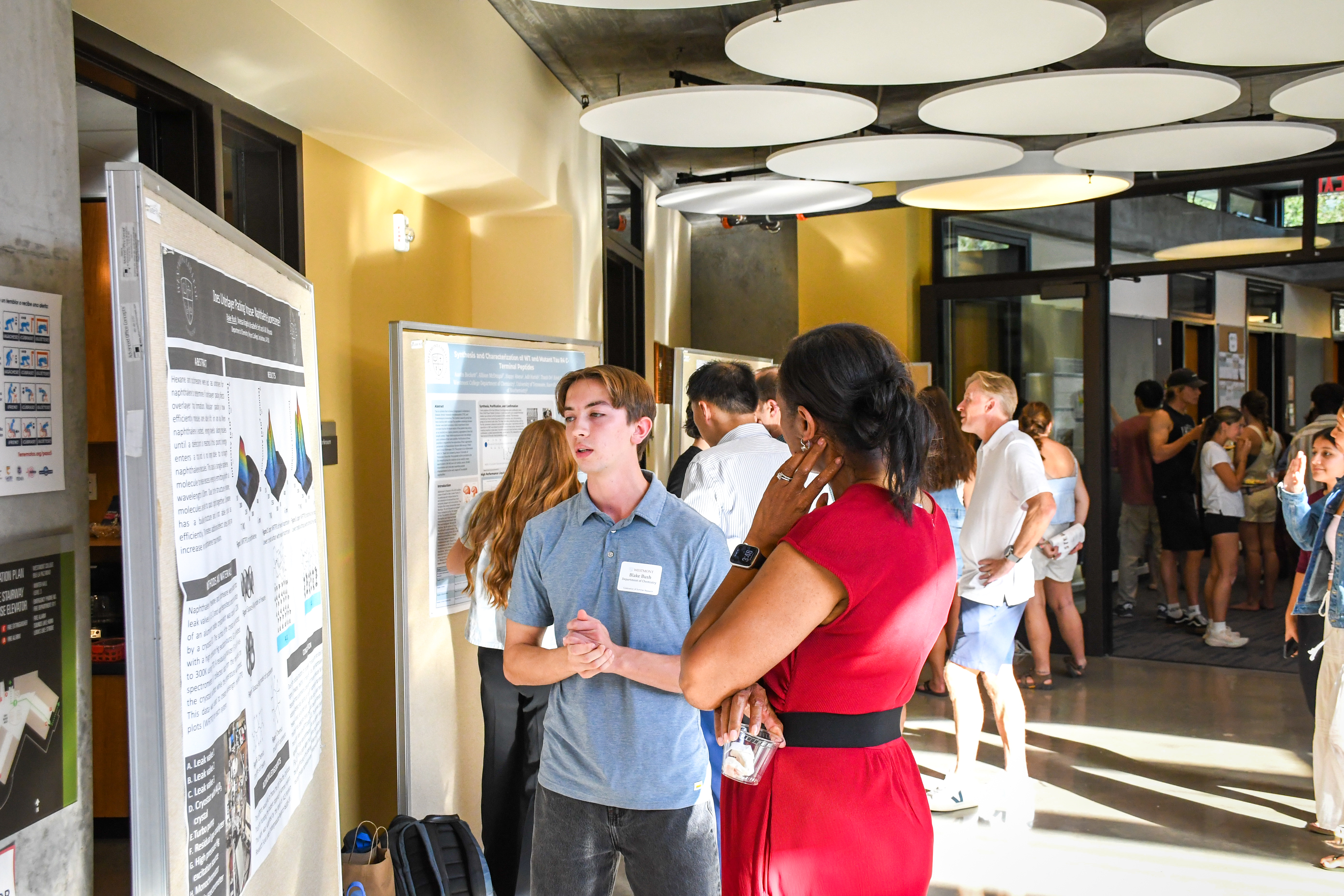
About 30 student researchers presented 20 different projects at Westmont’s annual Celebration of Summer Research on Oct. 16 in Winter Hall’s third floor atrium. Many of the students worked as paid, full-time research assistants, collaborating closely with professors on cutting-edge projects that often extend into the academic year.

Select poster titles from the natural and behavioral sciences division included: “Downsizing the Dome: Evolutionary Patterns of Head Size Reduction in Island Reptiles,” “Purported and Measured Waveform Characteristics of Vagus Nerve Stimulation Devices,” “Making Trust Fun: Development and Testing of Biofeedback Games for Pediatric Limb Loss” and “Quasiperiodic Drip: Percolation on the Penrose Tiles.”
Biology major Abigail Lackey ‘27 presented her team’s evolutionary research examining head size reduction in island reptiles across five Channel Islands species. Investigating whether diet, burrowing or general dwarfism explained the head size changes, Lackey noted that prey size proved the most compelling factor. “Dwarfism alone isn’t the best gauge of why there’s this head size change,” Lackey said. “Our prey size hypothesis gave us the most consistent results across all five species.”
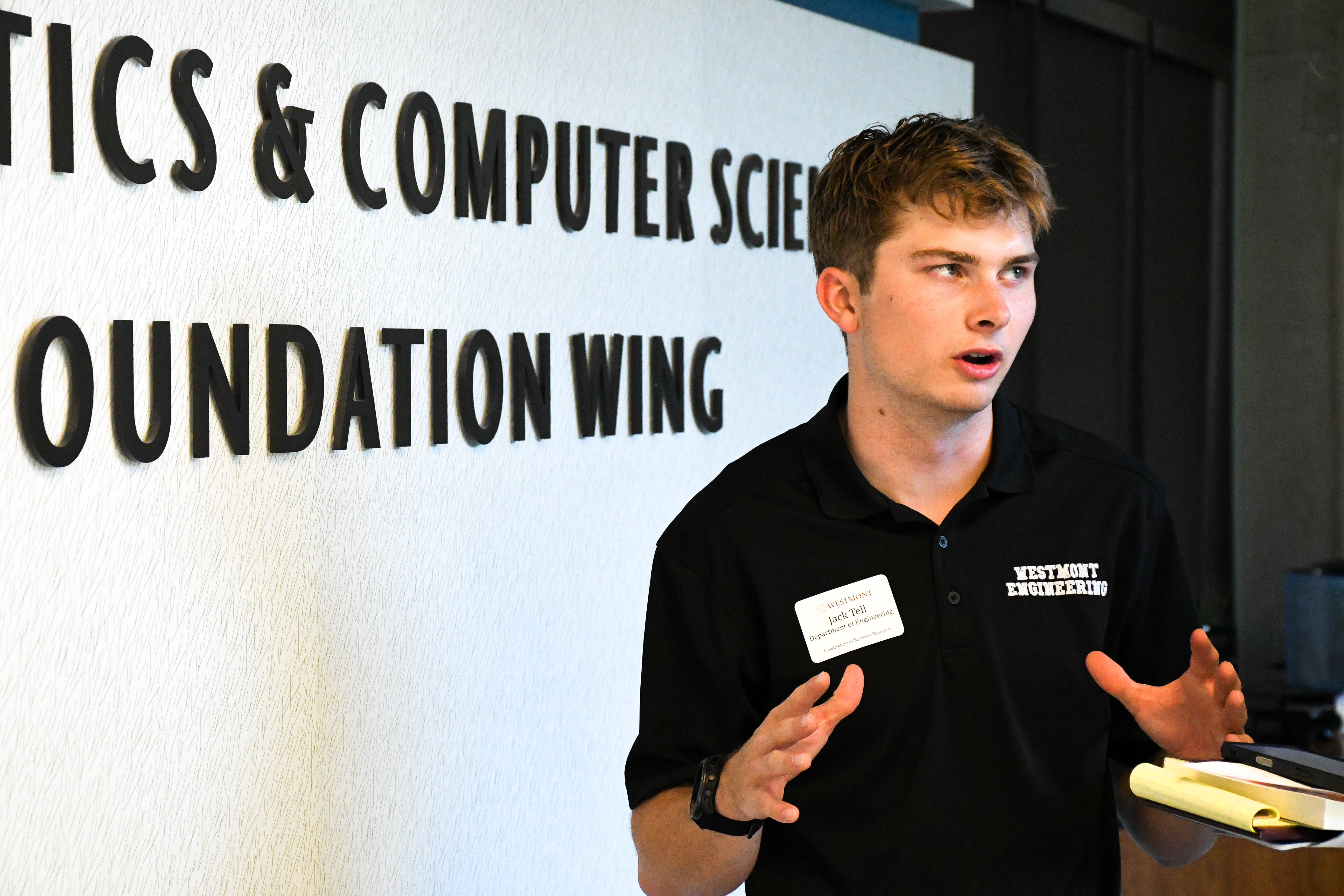
Engineering student Jack Tell ‘28 worked with Daniel Jensen, engineering director and Allder professor of science and technology, officials at the Air Force Research Laboratory and the 711th Human Performance Wing to evaluate five commercial vagus nerve stimulation devices designed to help military pilots manage stress and sleep deprivation on extended missions. Testing the devices on an oscilloscope, the team identified discrepancies between advertised and actual electrical output. “We were able to provide researchers and psychologists with the data they need as they continue testing them on real human patients,” Tell said.
At Westmont, about 1,300 undergraduates enjoy a student-to-faculty ratio of 11 to 1 and an average class size of 18, allowing them to develop close relationships with outstanding faculty committed to teaching, scholarship, research and involving undergraduates in meaningful discovery. Some students even co-author scholarly papers with their professors.